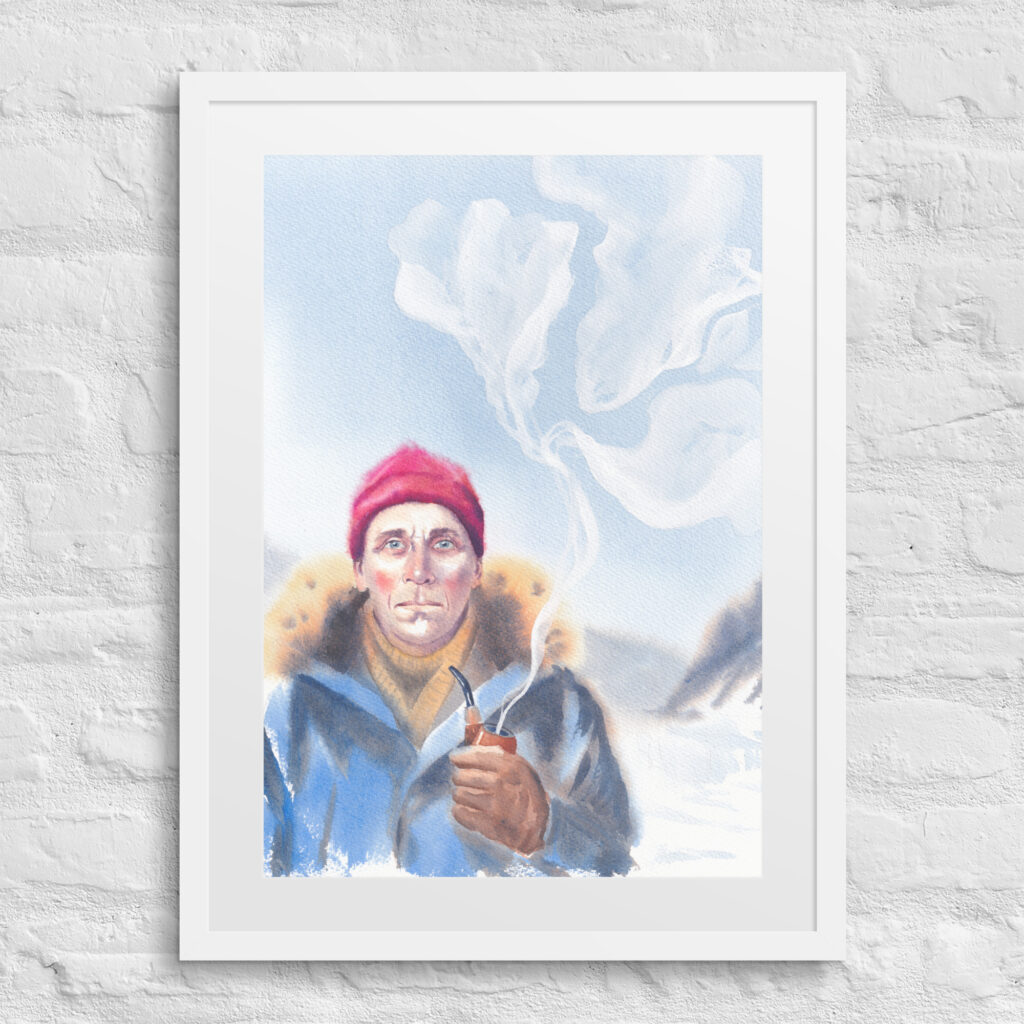
Alfred
Plate tectonics theory is one of the basic things we all learn at school in science class, and we accept it as a default. At least, I did. It sounds obvious, logical; you do not even question it.
I remember I was astonished when I first learned that it is a quite new theory widely accepted only in 1960s and before that time, most of the scientists rejected and ridiculed those who proposed tectonic plate movement being responsible for the current shape of our continents.
Despite him not being the first one and the only one to be vocal about it, the best known and widely accepted name as a father of continental drift theory is German scientist Alfred Wegener.
Born in 1880 in Berlin, excelling at school and later at university, where he studied physics, astronomy and meteorology, he quickly earned a name as being highly intelligent and therefore wanted in various institutions for various positions. First as assistant in an astronomical observatory, later as astronomy and meteorology lecturer, meteorology and geophysics professor and finally as head of the whole Meteorological Department.
Wegener spent most of his lifetime studying Arctic weather, participating in and organizing Greenland expeditions, exploring the least known parts of the island, pioneering air movement studies, and educating the younger generation.
Amidst all his work and significant commitments to meteorology and climatology science, he also showed a special interest in geology and developed the theory of continental drift. He said that South American and African coasts look alike because they used to be part of the same continent. He pointed out that having identical fossils and rock types on either side of the ocean isn’t random—it shows they used to be connected.
Back in 1912, Wegener released his book “The Origin of Continents and Oceans” for the very first time. He ended up republishing it a few more times, adding additional evidence each time. Even though recognized by few, he was still mostly ignored by the geoscience community.
He died on his third Greenland expedition in 1930, not knowing he’d end up as the main guy tied to plate tectonics.
If you look him up online, you’ll find some photos of him, quite a few being from his Greenland expeditions. All these photos are in black and white. So I painted a bright and colorful portrait of him instead with a bit of symbolism. I have a feeling that he never wore a pink beanie, though :))
I made this portrait and few accompanying illustrations available as wall art and postcards, you can find them on my Shop
Mary
Do you know Mary Anning? Had you asked me this a few years ago, I might have said maybe, as I feel I heard that name somewhere but cannot recall anything about her. I don’t know if it is a shame or not, but her biography somehow slipped past my radar when I was studying geology at university. Maybe it was never even told; I cannot remember it now.
I re-discovered her properly a few years ago when I had a wonderful week of geology-themed holidays in the south of the UK. And you might already have guessed it – I spent a couple of days at Lyme Regis – home of Mary Anning. I spent the first day visiting museums and exploring the town, with a fossil hunt planned for the second day.
I came prepared – packed a solid raincoat for my trip. After all, it was springtime, and the action was in the UK! Ironically, there was only one day during the entire trip that I needed it. Guess which one…
And even though, internet says that the coast of Lyme Regis is the attraction point for summer visitors, as it is one of the sunniest parts of the country, I can not imagine it other than foggy bluish-grayish haze colored panorama. Dreamy and calm hues.
I was going through those misty Lyme Regis photos one day recently and thought, ‘Oh, it would be interesting to draw Mary Anning in this environment’. But I did not want to copy famous portraits of her. I reinterpreted her and showed her as a young woman of today’s . Strong, dedicated, confident. I love how this painting turned out! It captures exactly the mood I was aiming for!
Having completed this painting, I realized I should depict more of Mary’s life story in the illustrations… So first I had to learn it. I found a few moments from her life that got me wanting to draw something.
You can find out more about them, as well as accompanying pictures here on my substack: https://strikedip.substack.com/p/mary
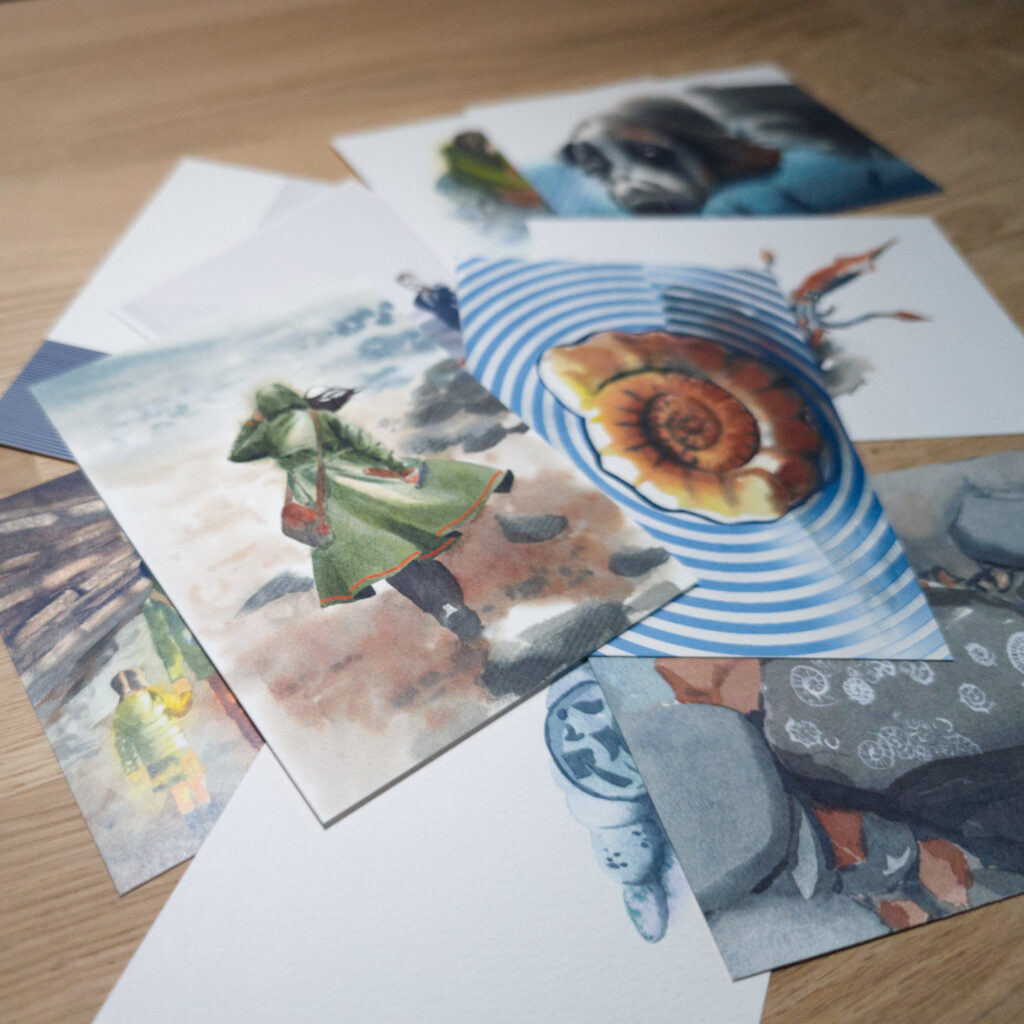
I made some of the illustrations available as wall art or postcards, you can find them on my Shop
100 Heads Challenge
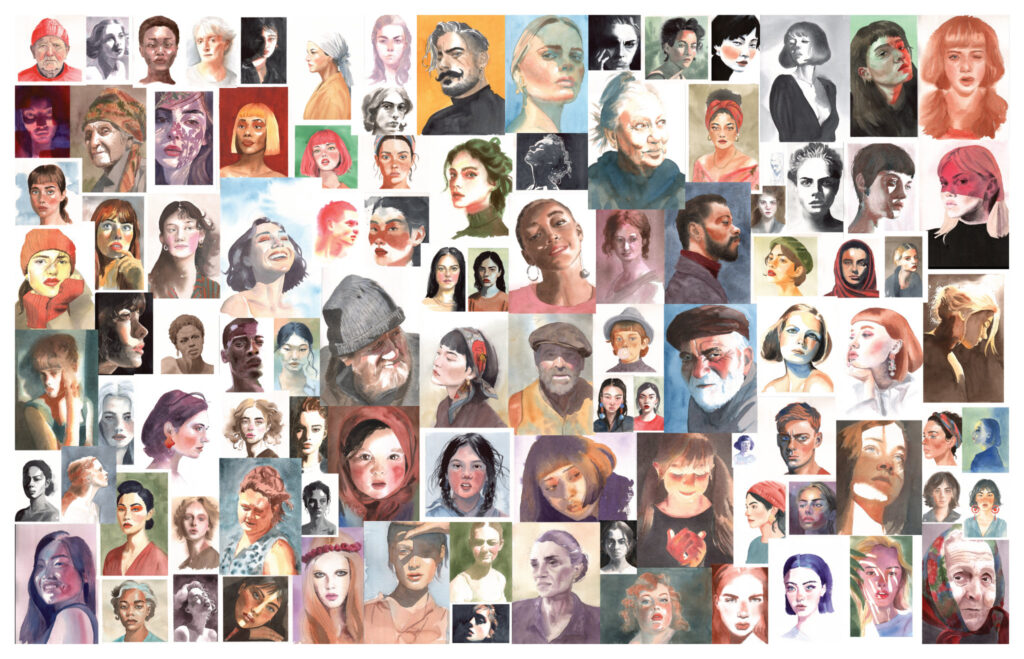
100 heads challenge is quite a popular activity among the artists who want to improve certain skills. The idea is to collect an inspiration board of 100 faces or heads and simply draw them, preferably in as short time as possible.
Doing so artists aim for different goals: some focus on similarity studies, others study anatomy, some are trying to better understand how their medium of choice behaves, others use it as a reference for their 3D modeling practice and so on. There are no real rules of how should you exercise your personal 100 head challenge. And there are no rules of how long your challenge should take really. Even though, in order to avoid procrastination and perfectionism, you are encouraged to make is as quick as possible, reality is that it varies a lot. And I mean a lot. There are people who finish it in a week and there are those who works on it for a few years.
I myself decided to do this challenge because in recent years I re-discovered watercolor and was really curious to try it on portraits. I wanted to understand how watercolor medium behaves, how my pigments mix and interact with each other, I was mostly interested in coloring, in watercolor application. So the line-work used as a basis for these portraits is simply just copies from the reference photos that I collected from Pinterest.
First portrait is marked with date 2025 November 7 and the last one with 2026 February 27. So it is 4 months total, I had holiday season in between, also covid-fest and some other fun stuff.